Tape 201: Jokes, Magic Tricks, Whodunnits
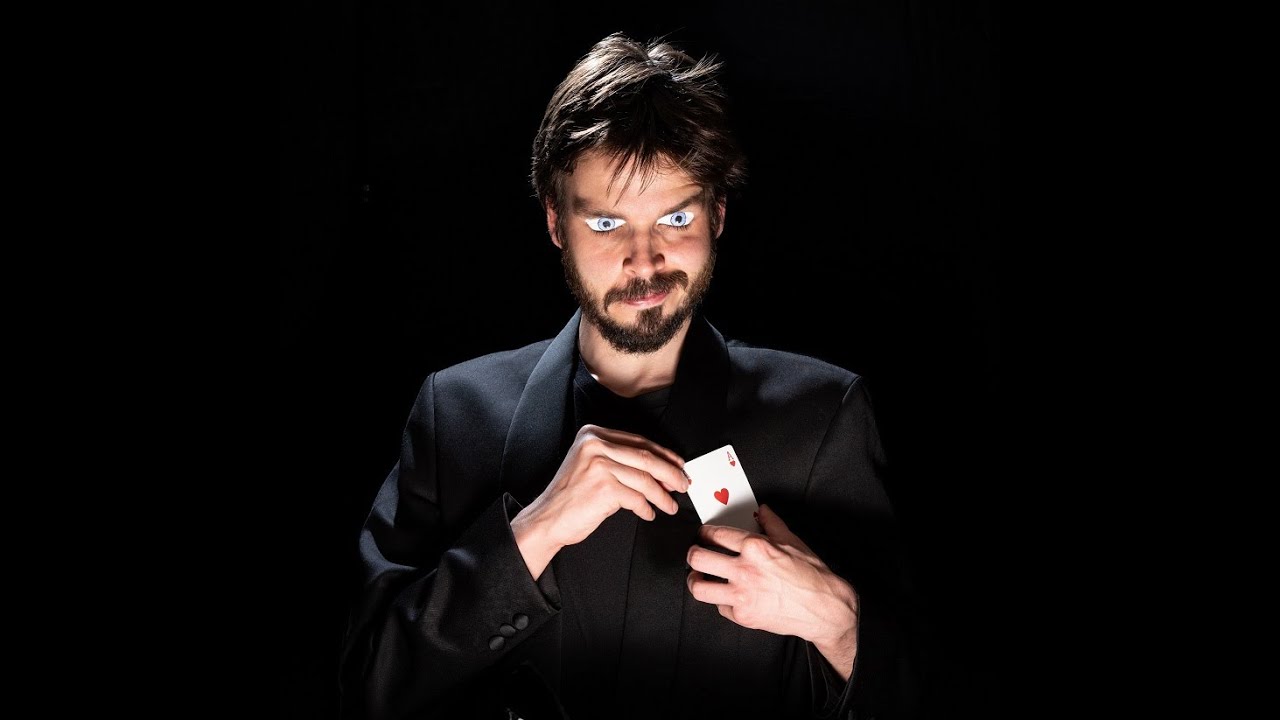
A few years ago I made a comedy show about magic. Perhaps you remember it? The one that ended with me and Ben Target dancing to AC/DC and telling the audience to go fuck themselves, shortly after I’d removed all my clothes, smeared myself in pickle juice and shouted “Fresh fish!” at the audience to the tune of “Roxanne.” I still feel bad for the people who came into it thinking it was an actual magic show, which I think was about half the audience for the last two shows. I made this show because I’d become really interested in the crossover between comedy and magic. “But Joz,” I hear you cry, “just last week you were complaining about pretentious artists who equate creativity with magic.” Well that’s true, I was, but I was talking there about people who think that, say, writing a blog post is somehow the same thing on a cosmic level as, I don’t know, saving a life, or turning yourself to stone in order to wait for King Arthur to return to Albion. I’m talking more about David Copperfield chopping his own legs off with a big laser and then hopping around an arena carrying his legs in his hands, which is functionally exactly the same as me having my trousers zapped off by an audience member’s thoughts and then telling a story about a sausage.
I’d done some work on a Derren Brown show that year (clang!) and become very interested in how magic tricks function, as it had occurred to me that they function in exactly the same way as jokes. I had therefore decided to see if it was possible to make a show that contained basically no actual magic, but was structurally identical to one big magic trick, ie. I tell the audience at the start of the show that I’m going to achieve an effect. I spend the show distracting them from the thing I’ve told them I’m going to do by pointing their attention in a different direction, and at the very end of the show I do the exact thing I told them I was going to do in the simplest way possible using a method none of them have thought to consider because they were too busy thinking about the other stuff I was bullshitting them with. It worked! I really loved that show, and one of the things I loved most about it was the number of magicians who were really impressed by it despite my total lack of magical ability. They got what I was doing with it.
Magic tricks and jokes are deceptively similar, because both of them only work because of the information you withhold. A magician who produces a playing card from an unexpected place and, instead of saying “The card has now reappeared over here!”, says “Behold! A different playing card which I planted here before the show and didn’t tell you about!” would be a bad magician (but it would also be funny). Similarly, a comedian who says “I was on the bus and I saw someone doing something they shouldn’t have been doing on the bus, and then I got off the bus” is not a good comedian (but again, it would be funny – this is an old Lee & Herring joke refracted via the Mayor & His Daughter in the version we came up with for their show last year).
In order to become a good writer and performer of jokes, and a good designer and performer of magic tricks, you need to be able to walk the line between what you’re showing/telling the audience and what you’re withholding from them. In both comedy and magic, there are two realities – the reality you’re living in, and the reality you’re constructing. In magic, you present things which are entirely physically plausible in the reality of what you’re actually doing but which are conceptually impossible in the reality you’re presenting to the audience, so those effects read as miraculous. A magical effect works because you never reveal to them the reality you’re actually living in (ie. rather than making this thing travel across the room instantaneously, because that’s impossible, I conceal it here and reveal an identical object there which had previously been concealed).
In comedy, you present an idea seemingly in one context (“My school was a bit rough, it was full of violent delinquents who couldn’t even string a sentence together!”) which takes on a completely different meaning when you reveal the context it actually exists in (“and that was just the teachers, hahahahahaha, you thought I meant the kids, I tricked you!”, and that effect reads as funny (note – you do not have to include “hahahahaha I tricked you” every time you tell a joke, but it can often heighten the comedic effect. Thank you for coming to my comedy course). The comedic effect happens when you reveal to them the reality behind the one you were constructing. So the effects of comedy and magic move in opposite directions, but both are art forms whose success is built on if, when and how you reveal information to the audience.

I had thought that I’d had a lot of fun exploring these crossovers and was now interested in new ideas, but it occurred to me over Christmas that I’ve once again found myself back in the same waters as a result of getting really interested in the third genre of storytelling that operates on the same principles – mysteries and whodunnits.
I love whodunnits. Always have. I think my dad has read every single detective novel ever written, and his love of unravelling a mystery and solving a puzzle got instilled in me very early on. In the last year or so I’ve been working on an idea for a comedy whodunnit called The Last One You’d Expect (we read some extracts from it at Eggbox last year). The intention was to try and write a comedy whodunnit that doesn’t compromise on either the comedy or the mystery. Very often when I see things that brand themselves as “comedy mysteries” they either read as outright parodies, where the mystery and any sense of genuine intrigue or satisfaction from trying to solve it, is entirely secondary to a general sense of silliness. Or, they read as more gentle fare where the mystery is satisfying and well-constructed but the laughs are there to jolly the thing along rather than being a key part of how the story is told. Both are good! But I just can’t think of many examples of things that don’t compromise on either side of the equation, and I’ve been trying hard to write something that I think honours both expectations and have been absolutely loving it. It’s by far my favourite scripted project I’ve ever worked on.
I’d been working on it quite hard for a while, then had to put it to one side in order to focus on You Wait. Time Passes. for Edinburgh. Then I came back to it and started to really dig into it again, and then over Christmas I watched Wake Up Dead Man, Rian Johnson’s new Knives Out movie. Those movies are exactly the kind of thing I wish more people were making. They’re not in the least bit pretentious, and genuinely succeed as big, popular, commercial movies. They also don’t dumb themselves down in the slightest, and tell genuinely smart, ambitious and inventive stories that subvert your expectations. In an age where nearly every film has to actively telegraph itself as either “This is a clever film for arthouse cinema nerds that is not going to make any money” or “This is a film for casual movie-goers which needs to make lots of money,” I wish more filmmakers like Johnson were being given the opportunity to make intelligent, innovative crowd-pleasers.
It also made me realise that, just like the work I’d done on Blink, I was once again dipping my toes into a genre that is all about information and how you reveal it. I’m not going to include any spoilers for Wake Up Dead Man because it’s brilliant and you should watch it if you haven’t, but after I’d finished it I went back and rewatched certain scenes in the first act to find out if things we were told about later had been in plain sight when we first saw them. Lo and behold, every clue we’re eventually given on how the murder was carried out is included directly in shot when we first see events, but you don’t see any of it because you don’t know to look for it. A good whodunnit therefore functions like a magic trick that walks the line between two realities – what you’re actually looking at, and what you think you’re seeing – but it’s a magic trick where you are eventually told about the things that were hidden from you, but only after the point where you’ve fallen for the opportunity to not pay attention to them.
The most ingenious element of Wake Up Dead Man, though (in my opinion) comes back to what I was saying about the connection between comedies and mysteries. Again, no spoilers here, but what I was most impressed by at the end of the film was the reveal that THE most crucial moment of plot development is initially presented to us as a gag. Not only does the moment itself read as a gag, but there are several scenes of setup to it that instruct us to read it as a gag and give us no option other than to read it as a gag. The final reveal that actually we weren’t watching a funny moment but the exact moment where the entire mystery of the film was set in motion, and is set in motion as a direct result of things we had just seen at the time but didn’t pay enough attention to, felt like exactly the kind of thing I’d wanted to see more of when I started working on The Last One You’d Expect.
There are so many comedy murder mysteries that are functionally well-plotted mysteries sprinkled with gags. There are so few that actually use comedy as a storytelling tool that reshapes our perceptions of the mystery. Both genres are often dismissed as inherently lightweight or disposable, but like magic, they’re genres where you can actually take really big swings in how you tell a story, and where you can place the audience in relation to that story. I’ve come into 2026 feeling really excited about this whodunnit idea, and looking forward to whatever happens with it next, and a lot of that fresh excitement is down to what Rian Johnson achieved with that film, so I urge you to watch it if you missed it! Whether or not the thing I’m working on ends up being as good (or even as much of an actual-thing-that-exists-in-the-world) as the Knives Out movies remains to be seen (read: doubtful), but I’m looking forward to the ride!
A Quick Plug – The tour started so nicely, thank you to everyone who came to Leeds and Oxford! Next stop – Norwich on the 31st, back in the city where I first started doing comedy! Thereafter there’s a break in the tour while I spend February trying out some early WIPs of the new Hugh Jackman/Phantom show, at the Pleasance on the 7th and in Leicester on the 13th. It’s going to be so stupid, I’d love you to come if you’re in either place!
A Cool New Thing In Comedy – I usually try to use this section to plug stuff that isn’t my own work, but I’m going to cheat and plug the three shows I’m directing this year! I mean, technically it’s not cheating because they’re not MY work, they’re things I’m working ON. Subtle distinction. So – go see Anna Leong Brophy’s solo debut show at the Pen Theatre on January the 29th, at the Pleasance on February the 20th and/or in Leicester on February the 22nd! Go see Emmeline Downie’s debut show in Leicester on February the 22nd and/or at the Pleasance on March the 3rd! And go see Alice Fraser’s new show at the Adelaide Fringe from February the 24th to March the 1st (NB Must be in Australia to be able to do this one). I’m so excited to be working on all of them, they’re going to be brilliant.
What’s Made Me Laugh The Most – Last week, when discussing Marty Supreme, I expressed an opinion on public spanking which made Miranda laugh until she doubled up and could no longer walk because she thought it was so weird, and you can’t see someone laugh that much without losing it yourself. I stand by my opinion, however.
Book Of The Week – Just finished The Princess Diarist by Carrie Fisher, a memoir on her time filming the first Star Wars. It’s a really interesting study of unexpected celebrity and the casual sexism that swirled around the movie industry in the 70s (and still does, of course). I had no idea she was such a funny, frank writer and off the back of this I’m keen to read some of her novels and other memoirs.
Album Of The Week – Secrets of the Beehive by David Sylvian. Discovered Sylvian at the end of last year via his collaborations with Ryuichi Sakamoto and Robert Fripp, so am dipping my toes into his solo work. It’s somewhere between Scott Walker and Mark Hollis, if either of those guys float your boat. Quite ambient, dreamy art pop. Real nice.
Film Of The Week – Rental Family I guess? It’s a pretty disposable, lightweight film which I enjoyed but didn’t love, but it was a lot better than Hamnet, which was the only other film I saw this week. I’m sorry but I thought Hamnet was really very bad, for so many reasons. Too many to get into, but just to include one of the least important ones – I actually LOLd at the idea that the first actor ever to play Hamlet delivered the “To be or not to be” speech sat on the edge of the stage at regular speaking volume. Presumably everybody at the back was thinking “Well this is shit, can’t hear anything,” but we don’t notice them because we’re too busy being bludgeoned to death by that Max Richter piece that has already been in literally every film ever, despite the fact that they already had an original score also by Max Richter that they could have used instead. Woops, I’ve started ranting, and I was supposed to be talking about Rental Family. Rental Family is a nice film that is quite good.
That’s all for this week! Let me know what you thought, and feel free to send this newsletter to a friend if you enjoyed it! Take care of yourselves until next time,
Joz xx
PS If you enjoyed this and wanted to make a one-off donation to my Ko-Fi account, that would be very nice and cool.
PPS Congratulations to the people of Oxford for being the first sold out show of the tour! Let’s keep ‘em coming, yeah? Photo of me in Oxford holding a jar of marmalade:
