Tape 213: I Wrote A Screenplay!
As I write this, I am enjoying the feeling of having just completed the first draft of my first ever feature film screenplay. I’ve never done that before – it’s always been one of those “I wonder what that would feel like?” question marks in my career, and I’m very proud of having done it. So this week, let me tell you a bit about what it is, what I learned from writing it, and what I’ll be doing next with it, before the inevitable tidal wave of “This is shit, why did I ever waste my time on this steaming pile of honking crap” sets in!
I mentioned back in September, when I was trying to work out what to do next off the back of the success of last year’s show at the Fringe, that I was considering the idea of writing a feature for the first time. This was for a lot of reasons, but the main one was structural. In the comedy industry, when it comes to generating ideas for scripted projects, it feels like we’re mostly encouraged to think in terms of TV half-hours, because for a long time there was such an established pipeline for that. Comedians and writer-performers would hone their voice and build their audience through the live scene, then that might turn into a radio sitcom, which might then make the leap to TV. A half-hour script has always felt like a logical next step from making live shows.
So for years, if I ever had an idea for a scripted project that was too ambitious to be a small thing I could make by myself, I’d try writing it as a half-hour to take to production companies to develop and pitch. Some of those ideas had more success than others, some got close to being made, some got nowhere near, but over the years I honed my own ability to write a decent half-hour. But looking back now, I can see that there was a problem that followed me around during that time – for a lot of those ideas, a TV half-hour wasn’t always the perfect format to realise it.
It’s relatively rare that I come up with an idea which feels objectively like something we should keep returning to again and again and which can always reset and generate ongoing opportunities for fun and drama, like a classic TV comedy ought to. I tend to come up with ideas for stories which begin, get messy, escalate and then resolve. I would always attempt to work out how each of those ideas could turn into a long-running, returning series, because that question is always a high priority in development, but I worked on several ideas where it was quite hard to clearly see what the answer to it should be. Usually answering that question meant either infinitely delaying the ending I knew I wanted to build towards (frustrating as a writer and a viewer) or trying to come up with things that could happen after reaching that point (which felt kind of pointless for everybody).
In addition to that, over the last few years it’s become clear that the pipeline of “Build an audience and a reputation on the live scene, then start moving into developing projects for radio and TV” which looked to have once been a vaguely reliable model for career progression, was delivering less reliable results. As audiences moved online and development and commissioning budgets were slashed, I saw fewer and fewer examples of people actually getting things made that way – even hugely popular comedians with big followings were complaining about what a soul-crushing and unproductive experience it was trying to develop scripted ideas for TV. So it started to feel like, rather than seeing TV spec scripts as the logical next step for any idea I have, I’d be much better off just being more honest with myself about what format is the best fit for whatever I come up with.
At the same time, Miranda and I had been making more of our own short films and using Eggbox to meet people from the independent filmmaking community. Something about that community felt really positive, and moved me back in touch with the feeling of making something just because I wanted to make it, and not because I was trying to get someone else’s permission to make it. That was a really nice feeling, and that was why I started thinking about feature films towards the end of last year.
I initially wondered if the story of You Wait. Time Passes. might work being expanded into a big, dumb, cringe comedy film about a relationship breaking down and an idiot who was completely unwilling to do anything to save it because he was too busy tinkering with his “masterpiece” in his shed. I still think that could work, but I decided that as it’s a relatively simple, contained idea, it should in theory be quite easy to make as a short under my own steam, so I might be better off exploring it in that format first, seeing how it feels and then scaling up from there if there’s appetite for it.
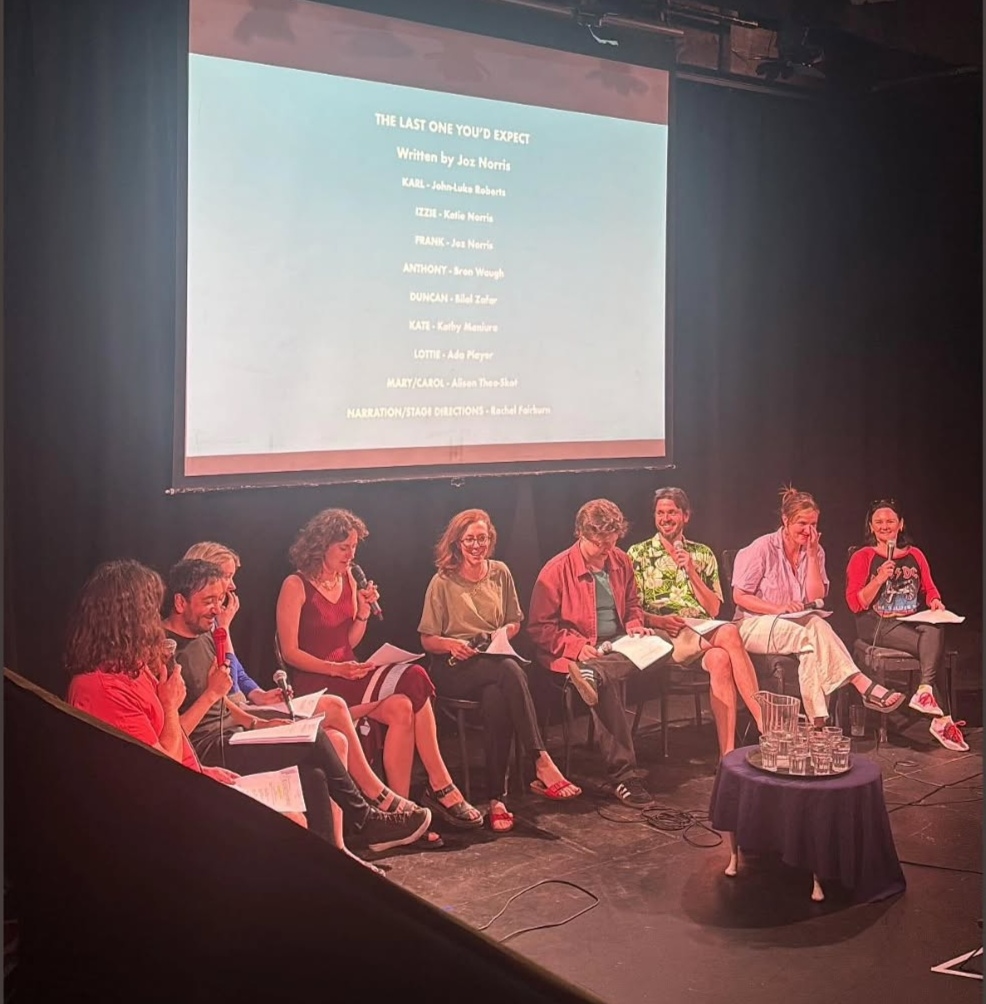
So that’s not the project I just finished a draft of. The other big thing I’ve been working on recently is a murder mystery called The Last One You’d Expect – you might have seen us do a couple of readings of some extracts from it at various Eggbox shows over the last couple of years! This was initially something I was developing for TV, imagining it as something like a comedic answer to The White Lotus. Understandably, the channels we pitched it to didn’t go for it in the end. Although The White Lotus has shown that there are approaches in that genre that satisfyingly answer the question of “What happens after the murder has been solved?”, a big prestige show like that has the budget and the clout to say “Well naturally every series is a new luxury location and a new star-studded ensemble and a new mystery.” Pitched as a small indie comedy from a relatively unknown writer, that sounds like a big risk at a time when TV commissioning is looking for affordable, returnable, reliable hits. So I could understand why this idea didn’t look like that for them.

A bunch of legends reading an extract from The Last One You’d Expect at Eggbox earlier this year.
Usually when I have an idea knocked back by TV channels, it feels like the best thing to do is to put it in a drawer and get on with other things, and see if my brain finds something else to do with it over the following weeks and months. Often, I don’t find that thing and it just becomes another old project that didn’t quite happen. This time, having already spent some time thinking about writing features, I just immediately clicked into a different gear with it.
“Hang on, maybe this isn’t a TV series,” I thought, “maybe it’s a film.” Murder mysteries are usually self-contained puzzles, asking people to remember back to something they saw earlier on but didn’t realise was important. It’s so much easier and more satisfying to construct that as one big story than by assembling it in lots of little chunks.
I had absolutely no idea what it would feel like to write it as a screenplay, or how I would know when I was done, and the thought of what I would do with it when it was finished was the furthest thing from my mind – God knows what you do to cross that bridge. But I knew that I had an idea I’d enjoy exploring that with, and I knew where the story went, so I started and then I couldn’t stop.
I’m so thrilled by how much I enjoyed it. It felt like all I needed to do was let the story unfold – I sort of instinctively knew when the tension needed to mount, when it needed to stop being funny and enter a different gear in order to feel truthful, when it needed to ease back into silliness again to honour its premise. Sometimes when I’ve been writing half hours in the past, I’ve found it difficult to negotiate moments where I felt like something dramatic or serious needed to happen, but that clashed against people’s sense (including my own) that the script needed to be a pure comedy all the way through. I didn’t necessarily want to write another comedy-drama that sacrificed laughs in favour of plot or pathos, but I found it difficult honouring the story I had in my head without including those moments, resulting in things that felt a bit like hybrids unsure of their tone.
But with this feature, simply because of the way the structure of the story played out, there were scenes where it just needed to become dramatic or serious, even if its primary purpose was still to be comedic. I didn’t need to be shy about including those scenes, because I knew where the story was going, I knew that it had a comic engine, and it was ok to let the story breathe or raise the stakes for the characters by letting things feel more real and earned from time to time. None of it changed my own sense of what I was writing the way it sometimes had when I’d encountered that feeling before in the context of writing a half-hour.
I’ve also written in this newsletter before about midpoints, which are a structural storytelling technique I learned from John Yorke’s excellent book Into The Woods. Most people understand three-act structure pretty easily, but Yorke explains that understanding the midpoint is if anything even more key to making a story work. It’s different to the inciting incident and it’s different to the third act crisis and it’s harder to spot than both of them, but once you’ve learned about them, you can start to recognise them in the middle of films you’ve never even seen before. Something will happen and you won’t even know why it’s going to be significant, but you’ll sense that something about the film has just changed and the rest of it is going to be different somehow. More intriguingly, if you work out what the midpoint of a film is and then check where in the film it lands, it will nearly always be in the exact middle, to the minute. I don’t know whether this is because all film editors know about midpoints and how they work (most likely) or because story structure itself is an elemental force that editors are in thrall to whether they fully understand it or not – possible, but a little insulting to editors, who are smart people who know what they’re doing.
But there might be something to the second theory after all – while writing the first draft I wasn’t completely sure what the exact midpoint of the story was, and imagined I would figure it out as I went. I got to a moment where the characters learned some new information, and immediately afterwards two of them had a conversation that changed the viewers’ perceptions of what was going on. While writing it I sensed that this was probably the midpoint, and I would have to come back and think about that now I suspected it. I knew what was going to happen over the rest of the story, but I had no idea how long any of it would take – I decided to just keep going through the beats I knew had to happen until I got to the end. Once I did, out of interest, I divided the page count in half to work out what was currently in the exact centre of the screenplay and was delighted to find that it was the start of that conversation. So maybe story structure is a primal force that works through us without our realising. Or perhaps my brain does just come up with ideas that more easily find their natural shape when I let the story play out in full rather than trying to carve it into half-hour chunks that resolve each time.
I think that all of these were skills that I’d learned from years of doing comedy shows the way I had. A lot of comedy shows essentially hang themselves on the premise of “What if this funny person existed? Look at all the funny things they would do,” whether that person is a character or a stand-up’s own persona. That type of show lends itself well to a recurring series, because we can just carry on enjoying spending time with that person.
Most of my shows, on the other hand, tend to be more like “What if this funny person existed? They would of course need to be destroyed,” which obviously limits how many times you can go back to them and go “This week they’re trying to host a party but it’s not going to plan!” Telling a story about a group of people who go through something chaotic and awful and are completely changed by it seems a much better fit for the way my brain deals with story.
I don’t want to say too much about what the screenplay is actually about, because I think it’s bad luck to give away too much of the ideas you’re excited about before you really know what you’re doing with them. But in a nutshell, it’s an ensemble comedy about friendships and relationships and lying and guilt and the versions of themselves that people perform for other people’s benefit, and all of that is disguised as an Agatha Christie-style whodunnit. There are two mysteries – the one that the audience and the characters are looking for, and the one that is the actual point of the story which hopefully goes unnoticed until the end (and two other red herring mysteries, actually). The thing I’ve most enjoyed about it is making these different mysteries rub up against one another so that it can satisfy the cravings of an audience who want a proper whodunnit, while also (I hope) doing something a bit different with the genre as well.
Of course, finishing this draft feels like a big achievement that I’m very proud of, but all it means is that now I need to go back over it and rewrite all of it and make it better. I still have absolutely no idea where you start when it comes to shopping a feature film screenplay around and trying to find opportunities for it, but I also know that what I have is a long way from being at that stage anyway. It’s all stuff I’ll figure out as I keep chipping away at it. If anybody reading this knows a bit about where to start when it comes to having conversations about feature film scripts and what might be possible with them, or has any advice or pointers for me as this project develops, I’d be very happy to hear from you! I’m very much in “Learning” mode on this project, I think, and keen to hear as many different ideas of where I could go with it as possible, to help me make good decisions. Is anyone else reading this working on a feature script at the moment? What have you learned from writing yours? I’d love to hear from you!
Further down the line I might try putting on a live reading of it to a small audience, just to get a sense of how it sounds out loud read by great actors, and how the pacing of it flows and so on. So maybe keep an eye out for that, and let me know if you’d be interested! In the meantime, I’m hugely proud of having hit this milestone, and very excited to have learned everything I have from writing something like this for the first time. Now it’s time to dive back into it, hack it to pieces and make it better!
A Quick Plug – Next week I’m bringing two shows to Berlin for the Berlin Fringe. Jackman/Phantom is there on the 17th and the first ever international Eggbox show is on the 19th with a programme of some of our favourite short films from the last couple of years, plus a reading of an excellent script by Berlin-based writer Kevin Napier – the best of the UK and Berlin scenes combined! Maybe see you there if any readers are based out that way!
A Cool New Thing In Comedy – Last week I mentioned that I was doing some WIPs of Jackman/Phantom at Soho Theatre in August, and now so are some other really brilliant people! I’d try to catch Mikey Bligh-Smith’s Full Frontal Mikey Mode and Kat Bond’s Eye Show at the very least if I were you.
What’s Made Me Laugh The Most – A line in The Invite about pegging.
Book Of The Week – James by Percival Everett, which is a retelling of Huckleberry Finn from Jim’s perspective. I don’t really know Huckleberry Finn very well, but this is brilliant. It reimagines Jim’s entire personality as a self-preserving construct to conceal his intelligence from the white characters, and it’s such a clever and devastating way to re-examine that story.
Album Of The Week – The Lion by Youssou N’Dour. This was just on the list because I decided it was high time I got more into Youssou N’Dour cos he’s great, and I didn’t even know it had the Peter Gabriel collab “Shaking The Tree” on it. I love that song! Anyway, this album’s great, Gabriel or no Gabriel.
Film Of The Week – The Invite, in which Seth Rogen and Olivia Wilde have Edward Norton and Penelope Cruz round for dinner and then everything gets sexy and crushingly awkward. A really funny, sad, excellent film.
That’s all for this week! Let me know what you thought, and as ever, if you enjoy the newsletter enough to send it to a friend or encourage others to subscribe, I’d hugely appreciate it. Take care of yourselves until next time,
Joz xx
PS Feel free to send me a tip on Ko-Fi if you enjoy my work and would like to support me to keep making it!
PPS The sun went behind this tree and I thought it looked nice:
