Tape 210: Pay Your Artists!
I’m gonna do everything I can to not let this week’s newsletter turn into a rant, because it could definitely go that way. I’d like it to just explore some ideas rather than moan about them, but let’s see how I get on. Apologies in advance if I don’t quite stick the landing.
Over the last couple of weeks I’ve had to speak to a few BBC journalists about the ongoing situation with Leicester Comedy Festival. “I understand I’m talking to this year’s winner of the Leicester Comedy Festival Award for Best Show,” they say. I chuckle to myself and kick back, resting my feet on a velvet cushion and beckoning my servant to come over and plop a grape into my mouth.
“That’s correct,” I reply. “Let me guess – you want an autograph.” I roll my eyes and shake my head. These journos are so predictable! “Who do I make it out to?”
“We understand you’ve not been paid?” they say. I remember that my servant is owed three months’ worth of wages and has started talking about injecting poison into the grapes if I don’t pay him what he’s owed. I also remember that the grapes and cushion have been purchased on credit and that there are loan-sharks currently trying to drill the hinges off my front door. I quickly wave my servant away so I can talk to the BBC guy more seriously.
You may have read this story on the BBC already, replete with photos of loveable scamp and comedy’s foremost Terry Wogan impersonator Ben Alborough. It’s a tricky situation to be put into in order to try and offer commentary on, because it’s a complicated issue and these journalists always want a quick soundbite. So I thought I’d talk about it in a bit more detail here. In a nutshell – due to some sponsorship funding not coming through, Leicester Comedy Festival has had to spend the ticket money it owed to artists in order to cover their operational costs, and it’s unclear when (or, to be completely honest despite their insistence, if) artist settlements will be paid.
With both the interviews I’ve given so far, I’ve made it very clear that I have no interest in being part of a take-down of Leicester Comedy Festival and Big Difference, the company that runs it. This sort of thing happens depressingly often in comedy (see also the recent closure of Seven Dials Playhouse), and sometimes it happens as a result of actively bad business practices – organisations stacking debts on top of existing debts without properly communicating with artists and crossing their fingers that enough money will suddenly appear to settle everything, before the whole thing inevitably collapses and nobody gets paid.
I don’t think that’s what’s happened with LCF – I don’t know whether a sponsor pulled out and let them down, or if they went ahead with the festival before a sponsor had fully committed, but whatever happened I think it was more a result of bad luck, naivety or bad planning than it was dishonesty or any kind of unscrupulousness (love the word unscrupulous, always makes me think of Mr Scroop, the alien lobster from Treasure Planet)
In previous years Leicester has always struck me as a well-intentioned and well-run festival and it’s a huge force for good in the comedy world more generally – it’s a fixture in the calendar where every year I know I can turn up and roll out a new show to a large passionate audience of local comedy fans. I’d like to see them find a way to solve whatever went wrong and survive, so I don’t really want to rake over the specifics of what’s happened here when I don’t know all that much about it because I don’t see how that helps them.
But I do think it’s an important opportunity to talk about a huge structural problem in comedy more generally, which is the way in which artists are constantly made to take on the financial risk of EVERYTHING. When we sign up to perform at festivals like this, we have to pay an upfront registration fee – usually around £100 – and then we have to cover all the marketing costs as well as the cost of transport and accommodation if the festival isn’t local to us. We also have to cover the creative costs of making the show itself – props, costumes, equipment, rehearsal space, collaborator fees, tech fees – although these costs obviously end up being spread across the show’s entire lifespan so should ultimately become cost-neutral by themselves.
Particularly when you’re starting out, you’re pretty unlikely to actually make any profit doing these festivals – if you aim to try and break even, have a good time, develop your show and build an audience then those are perfectly healthy, achievable goals. As time goes by and you build up a more reliable audience in these places, these festivals then become minor lynchpins throughout the year where you know you can turn up and make a small chunk of money off what you’ve built there. That’s why we spend our money on them, and in turn the festivals’ up-front operational costs are largely covered by our registration fees.
And yet, despite these festivals being directly funded and bankrolled by the artists who make the shows, we are often the last people to get paid, and when things go wrong it’s usually us who ends up empty-handed. Obviously I’m not going to argue for a reversal of this dynamic – where artists are paid first and hard-working festival staff, who are also essential to the smooth running of things, take on the risk of going home with nothing. But the current system is unfair, imbalanced and, I’d argue, exploitative.
This aspect of the business is particularly noticeable in TV, I find, where artists/writers are frequently the only people sitting in a development meeting who aren’t being paid to be there. It’s all done on the dangling promise of a potential payment further down the line if everything goes well with the project, but those eventual options and commissions are harder and harder to come by, which makes the whole process feel even more loaded against the people working for free.
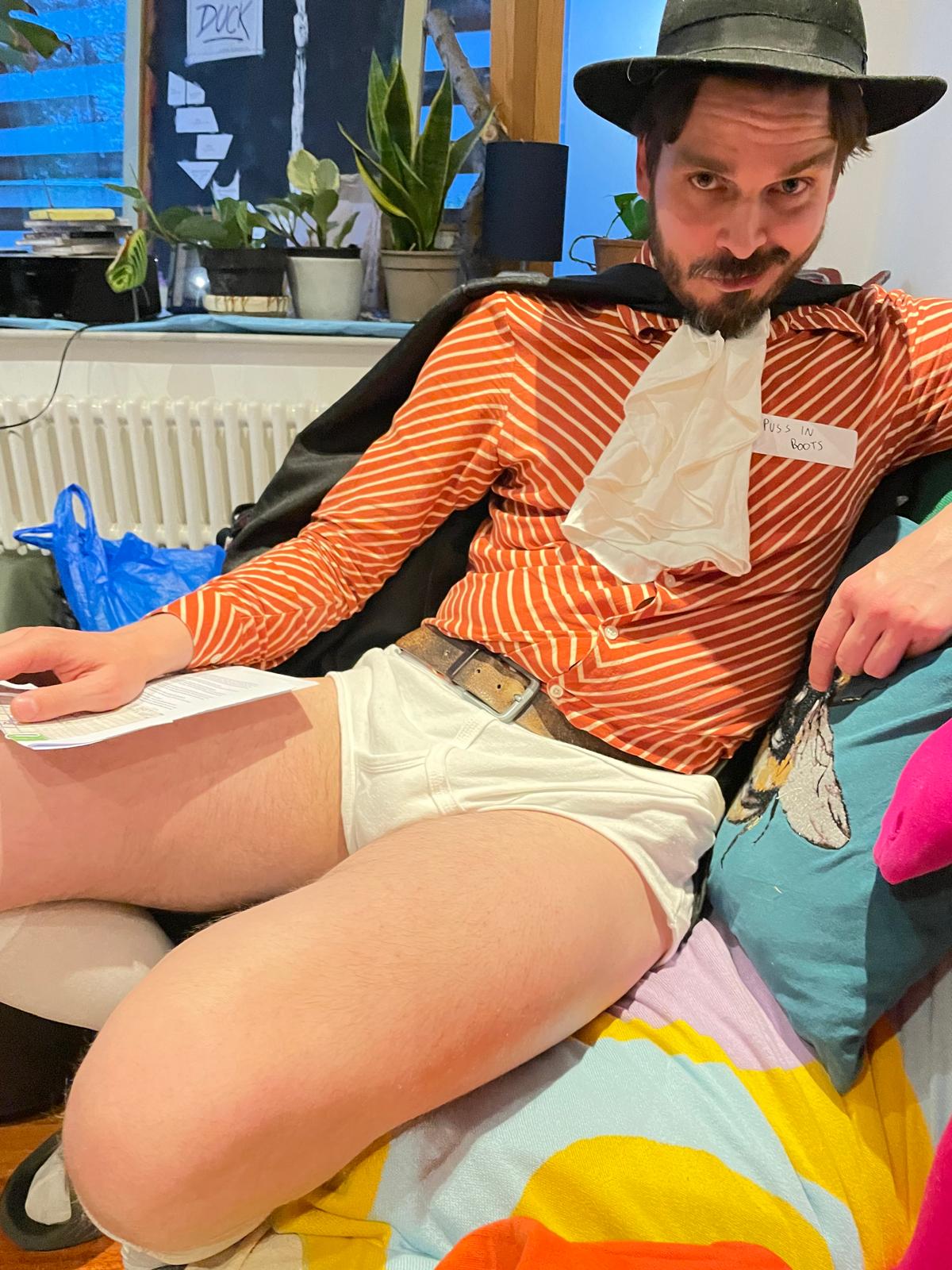
I wanted to use a photo of a huge pile of money as the main image for this newsletter, but then worried that if I sourced one from Google I might get sued for using an image that doesn’t belong to me. So instead I searched my camera roll for a recent picture of me where I look most like a struggling artist who needs to be paid:

Hence this photo of me dressed as Puss In Boots from Shrek. The Y-fronts were intended to draw attention towards the knee-high boots which were supposed to be an integral part of the costume that a friend had promised to bring but he forgot them so I was just a guy in Y-fronts and sliders talking in a Spanish accent all night.
At the same time, the comedy industry frequently looks at the relative lack of working class voices with dismay and bafflement. How can it be that despite various well-intentioned (and important, and necessary!) bursaries to give marginalised and working-class voices a start in comedy, they’re still struggling to find a sustainable place in this industry that is fundamentally structured on the concept of people devoting huge amounts of their time to it without necessarily being paid? Could it be that an industry structured in this way disproportionately favours people who are independently wealthy and do not need to work? The link between these things seems to be a huge blind spot for a lot of people, presumably because there is no simple obvious fix for it. But the lack of a simple obvious fix doesn’t mean we shouldn’t start calling it out.
(NB Obvious but worth pointing out – I say all this not because I’m claiming to be a marginalised voice myself because that’s obviously not the case. I’m the sort of middle-class wanker that the current system theoretically benefits, albeit one who muddles through and just about gets by as opposed to one with a huge safety net to rely on. I too massively struggle within this system because I have to pay rent and the industry frequently forgets that its artists need to do that. If it’s difficult for me, God knows what it’s like for people from more difficult backgrounds than mine who lack any sort of safety net whatsoever).
Some well-intentioned organisations – big production companies or agencies – try to help as much as they can by fronting the costs for things like their clients’ Edinburgh Fringe runs, because they don’t want cost to be a barrier for entry for anyone they work with. This is a noble aim, and it’s good that they do it, but these organisations also pay themselves back out of the ticket sales for that run, only passing on whatever’s left over to the artists. Because they have to cover their own operational costs, a Fringe run produced in this way frequently only breaks even, which means that even artists who are offered this kind of support must still be the kind of person who can afford to not work for a full month. This, again, skews the playing field. (This isn’t even mentioning the fact that the runs produced in this way that don’t break even and end up losing money nearly always pass their losses onto the artist).
It’s very rare to come across an organisation that factors artist fees – that is, a guaranteed minimum fee for each performance of a particular show, or each rewrite of a particular script – into their operational costs. Those that do will often then ensure they own the rights to the end product, which makes it harder for the artist to scale up from that minimum fee in the event that their project ends up being a big success. In nearly all business models across all different sectors of the comedy industry we generally find artists either directly funding things by fronting the cost themselves, or working for free for long periods of time, and we often see them pushed way down the list of people who need to be reimbursed for their work.
I’m aware this is in danger of becoming a rant, like I swore it wouldn’t, so let me offer some important caveats – I’m well aware that the people who work for these bigger umbrella organisations also work incredibly hard, and offer a vital element within the larger machine of what the comedy industry does. I don’t want to see a world where artists take no risks and take home all of the money as well as all of the credit and the acclaim, while other people work hard and take all the risk in order to maybe not be paid. The current model exists in part because artists benefit in other ways from a successful project – visibility, profile, portfolio, and so on. It’s important that the more invisible work which doesn’t offer as much in these regards is properly acknowledged and paid for. But I’d argue that currently we’re working within a model where visibility and profile are often the only payment an artist is guaranteed, and it’s literally not possible to survive within such a model. I’d argue that we ought to be trying to work out how to restructure the industry so that, ideally, nobody is being exploited and de-prioritised.
Like I say, I’ve no idea what happened with Leicester, or what should be done differently next time to make sure it doesn’t happen again. I’ve no idea what other things can be done to try and shift this frequently vampiric business model towards something fairer and healthier. I suppose performer fees becoming a ring-fenced part of any company’s business model would be a step in the right direction, but I imagine lots of businesses would immediately become unviable if that were the case. I have no easy solutions. But I do think there are only so many times we can be made to be totally responsible for the financial health of this industry and then have our money rerouted to cover other costs before we start actively talking about the ways in which this doesn’t work for us, and asking people to start thinking about how to improve things. So those are my two cents’ worth.
What do you think? If you’re a supporter or consumer of the arts yourself rather than a fellow maker/creator, how would YOU like to see the money you spend on it be distributed? What would be a sensible step in the right direction to start making it fairer for everybody? I’d love to hear your thoughts!
PLUGS:
EGGBOX – Our next Eggbox show is at the Pleasance on Tuesday, with a programme packed full of comedy shorts and new writing! We’ve recently secured the support of the good folks at Proper Corn to provide FREE POPCORN for all ticket-holders to make it a real night at the movies, and we’ve added the amazing Kathy Maniura to the cast for the live script reads and added one final mad film by the brilliant directing duo Big Red Button. Tickets available here!
JACKMAN/PHANTOM WIPS – The new beast continues to slowly evolve, coming to the Brighton Fringe on Saturday as part of Liebenspeil’s Weekend of Weird, and the Exeter Comedy Festival on the 6th of June.
YOU WAIT. TIME PASSES. FINAL TOUR DATE – The tour is nearly over but there’s one date left to go in Canterbury on the 20th of June! It’s been such a joy bringing this show to audiences around the country, and I’d love to send it off with a bang. If you live nearby or know people who do, please come down or help spread the word!
A COOL NEW THING IN COMEDY – The beguiling, bizarre, horrible, hilarious duo The Mayor And His Daughter, whose debut show A Genuine Appreciation Of Comedy I had the honour of directing last year, are coming to Soho Theatre for three nights next week! Do come and see them if you missed them at the Fringe last year, they’re unlike anything you’ve ever seen and when they inevitably fulfil their mission and dematerialise and return to the Source, I fear we will never see their like again.
WHAT’S MADE ME LAUGH THE MOST – I saw a WIP of Emmeline Downie’s excellent Gail, which I’m working on as the dramaturg, on Monday, and since I last saw it there’s a new joke involving the Pearly Gates which really got me. Such a good show, this.
BOOK OF THE WEEK – Still on Florence Knapp’s The Names. It’s brilliant but oh boy, it’s making me very sad.
ALBUM OF THE WEEK – Penguin Cafe Orchestra by Penguin Cafe Orchestra. For too long have I identified as a “fan” of Penguin Cafe Orchestra despite only having listened to their debut, Music From The Penguin Cafe, and the song “Perpetuum Mobile” as part of a compilation I had as a teenager called Classical Chillout. I’m diving into their discography and it’s excellent so far, especially the track on this album which is just a dialling tone, a rubber band and a few violins.
FILM OF THE WEEK – The Christophers, which I went into with perhaps slightly too lofty expectations because of the Guardian’s 5-star rave review. But it’s a really enjoyable and interesting drama about the value and worth of art and it boasts two incredible performances from Ian McKellen and Michaela Coel.
That’s all for this week! If you enjoyed the newsletter, feel free to send it to a friend or encourage others to subscribe. Take care of yourselves until next time!
Joz xx
PS Feel free to send me a tip on Ko-Fi if you enjoy my work and would like to support me to keep making it! (I mean, hey, those Leicester debts aren’t gonna pay themselves, right???)
PPS Look at this big spaceman made of flowers I found outside the Saatchi Gallery:
